
Pre-Commercial Procurement (PCP) is an approach to public procurement of research and development (R&D) services that is outlined in the PCP communication and associated staff working document. Pre-Commercial Procurement challenges industry from the demand side to develop innovative solutions for public sector needs and it provides a first customer reference that enables companies to create competitive advantage on the market.
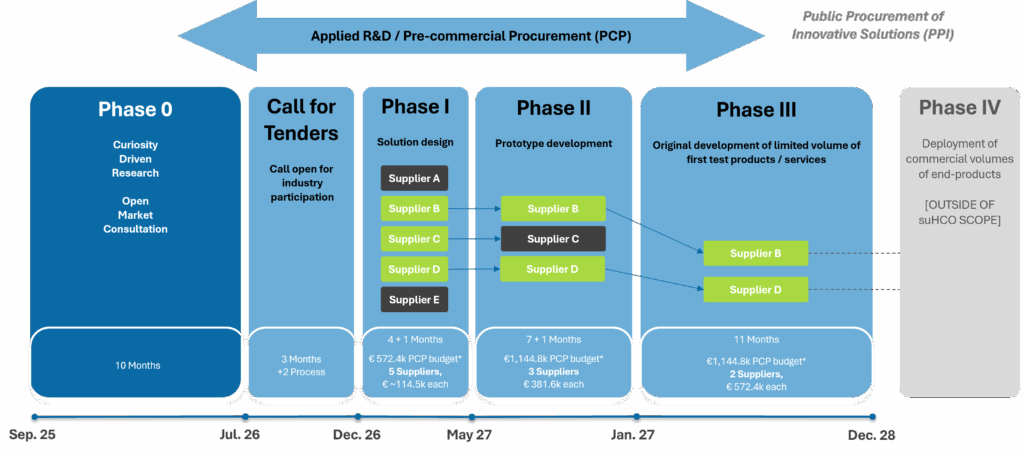
A Pre-Commercial Procurement (PCP) is particularly useful when no off-the-shelf solution exists and when stimulating competition is key. In a PCP like suHCO, the procurers don’t buy finished products. Instead, they fund several competing companies to research and develop possible solutions. The process happens in three phases:
- Solution Design – Multiple companies get funding to propose and sketch out different ideas.
- Prototype Development – The most promising ideas move forward, and companies build early versions (prototypes) to test if they work.
- Real-World Testing – A few final prototypes are tested in real conditions to see if they tackle the problem effectively.
At each stage, only the best solutions continue, so competition drives innovation. In the end, the procurers do not buy the prototypes — they just help create them. The companies keep their intellectual property (IP) and can later sell their innovations on the open market. If the procurers want to buy the best solution, they usually will get discounted prices, but have to launch a separate procurement process.
This approach shares the risk between the public and private sectors while ensuring that innovative, tailored solutions get developed.
Phases of the PCP Process
The PCP is implemented in three phases: Phase I focuses on solution design and selecting an initial set of suppliers; Phase II covers prototype development; Phase III scales up the solution based on previous iterations.
Please note that the numbers of suppliers and budget values are preliminary and that the term “Supplier” refers to the entire consortium. The consortium may distribute the budget internally.
Open Market Consultation (OMC)
The Open Market Consultation (OMC) is a series of events designed to inform potential suppliers about the suHCO project’s pre-commercial procurement opportunities. These events aim to clarify the procurement process, gather feedback on requirements and challenges, and facilitate collaborations among potential suppliers. An online survey and matchmaking service will also part of the OMC to gain deeper insights and aid potential bidders in identifying collaboration opportunities. Attendance at OMC sessions is not mandatory for tender submission, and all details from the events are accessible on this website.
Read moreCall for Tenders
The Call for Tender is a formal invitation to suppliers to submit proposals for the suHCO project’s pre-commercial procurement. This document outlines the general context and background, including the phased competitive development approach described above. It details the equitable distribution of IPR-related risks and benefits, exemptions from EU public procurement directives, and the importance of the Open Market Consultation. The Call for Tender specifies the services to be procured, the expected outcomes per phase, the tender closing time, the procurers and other parties involved, the contracting approach, and the total budget and its distribution per phase. It also includes the evaluation criteria for tenders, the content and format of tenders, and miscellaneous information such as language requirements and procedures for appeal.
Selection Process
The selection of suppliers for each phase is based on a rigorous evaluation process:
Eligibility and Exclusion Criteria
Participation was open to all types of operators from any country, regardless of size, geographical location, or governance structure. Tenders may be submitted by a single entity or in collaboration with others. However, there are requirements relating to the place of performance of the R&D services, with at least 50% of the total value of activities required to be performed in EU Member States or Horizon Europe associated countries.
Evaluation Criteria
The evaluation of tenders is based on exclusion criteria, selection criteria, and award criteria. Exclusion criteria include conflict of interest and grounds relating to criminal convictions, payment of taxes, insolvency, and professional misconduct. Selection criteria assess the tenderer’s ability to perform R&D, experience with multi-disciplinary and cross-organisational pathway planning, collaboration with public procurers, and capacity to commercially exploit the results.
Award Criteria
Award criteria are divided into on/off criteria and weighted award criteria. On/off criteria include compliance with the definition of R&D services, compatibility with other public financing, and compliance with ethics and security requirements. Weighted award criteria evaluate the excellence, impact, and implementation of the proposed solution. The evaluation committee, composed of representatives from the Buyers Group, assesses the tenders based on these criteria; they are supported by an Expert Advisory Board.
Contracting Approach
The PCP is implemented by concluding a Framework Agreement with each successful tenderer and Specific Contracts for each of the three R&D phases. A Framework Agreement and a Specific Contract for Phase I were awarded to seven contractors. Call-offs are organised for Phases II and III, with the aim of awarding three Phase II contracts and two Phase III contracts. Only offers from contractors that successfully completed the preceding phase are eligible for the next phase.
Involved parties
The PCP process is conducted jointly by several public organisations forming a buyers group, led by a Lead Procurer who initiates the procurement process and signs the framework agreement and specific contracts on behalf of all member organisations.
Read more